
How Abdul El-Sayed Thinks
A never-published account of my time with him on his first campaign

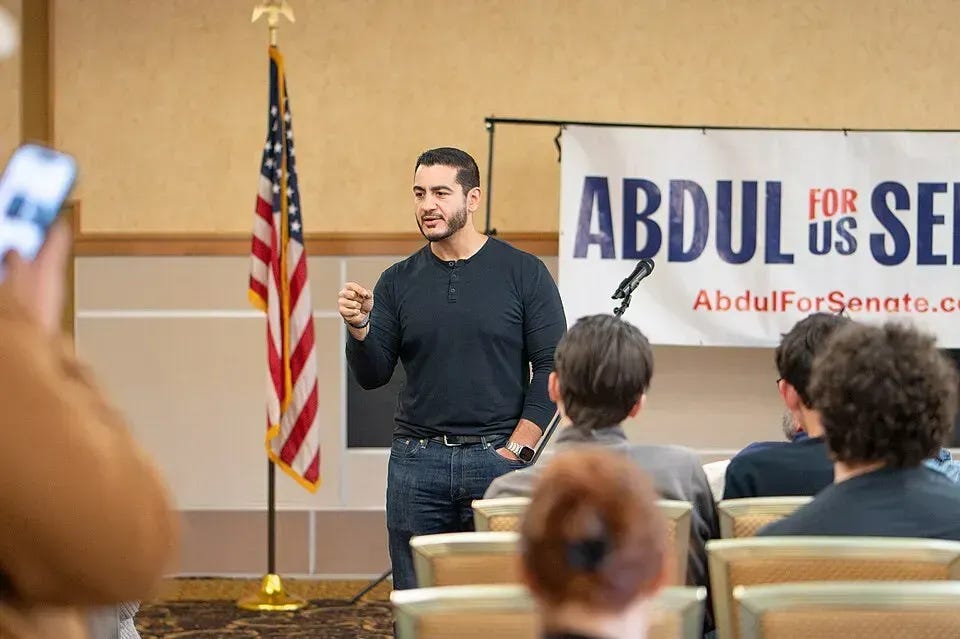
Eight years ago, I spent a LOT of time with both Haley Stevens and Abdul El-Sayed as they ran their respective 2018 races for Congress and Governor. As I wrote this week in the Wall Street Journal, Haley and Abdul haven’t changed much since back then. They’re the same candidates talking about the same issues in the same state; but the party and the country have changed around them. That’s why El-Sayed is probably going to win the Michigan Senate Primary tomorrow.
In 2020, I published The Ones We’ve Been Waiting For: How a New Generation of Leaders Will Transform America. Both Haley and Abdul are featured prominently in the book, but Haley got more pages, because at the time she was a sitting member of Congress and Abdul was a former gubernatorial candidate (political reporters spill a lot more ink on winners than losers… them’s the breaks).
But I wrote an entire chapter about Abdul El-Sayed that got cut in the final rounds of edits. This chapter was based off of multiple campaign events, hours of interviews with Abdul and his family, and my experience in the room when he lost his 2018 election. Funnily enough, Roxie Richner, the young supporter featured in this chapter, was too young to vote for Abdul when she volunteered for him in 2018; now, she’s his communications director.
Ahead of the primary, I’m publishing a condensed and edited version of that chapter below.
* * *
At 1 o’clock in the morning in a bar in Dearborn, Michigan, in the summer of 2018, Abdul El-Sayed sipped his avocado milkshake and reminded himself that he was going to die. It wasn’t intentional: he didn’t want to die. He wasn’t a sad man. It was just a fact that he knew about himself, the way he knew that he was better with numbers than with names, or that he didn’t forget faces, or that he couldn’t be happy unless he was running something. He was absolutely certain of it: he didn’t have very long on the planet, he would have less time than other people, or less time than he needed. He can’t remember when he decided this-- he’s built like an ox, doesn’t have any chronic illnesses or pesky genetic predispositions. His wife Sarah says he’s felt this way as long as she’s known him. But he didn’t have time to think about why he felt this way or what his end might look like. He was in too much of a rush.
He never feared this certainty of death. He says his ambition comes from sadness: sadness that people lead such terrible lives, and that the system not only blames these people but then forces those people to blame themselves.
But the ambition isn’t really from sadness. It’s from anger. And impatience.
* * *
By the time Trump was elected in 2016, Abdul was running the Detroit Health Department. This was around the time of the Flint crisis, and part of his job was making sure that the Detroit water didn’t have lead in it. He got eyeglasses to every Detroit kid who needed one. He was 33 years old, running the health department of a major American city, but still he was itchy. Trump had called immigrants racists, called to ban Muslims from the U.S., and still he had been elected president. Abdul felt glum for months. He was going to work, but his heart wasn’t in it.
Then one morning, he did his workout, put on his tie in front of the mirror, and decided he would run for governor. Bernie Sanders had won Michigan in 2016 and Hillary Clinton had lost it. This was a state, he reasoned, where a progressive could beat a Republican. He had never held elected office, didn’t have any big connections with any of the Michigan power players, had no money or donors or name recognition, had zero state political experience. He was Muslim, he was brown, and his first name had 11 letters in it. Still, he figured, why not. He could tell a story about America that nobody else could tell, he thought. Better to try than to wonder what would have happened.
Running for Governor meant that Abdul was at the Lava Lounge in Dearborn at 1 am shaking hands and asking for votes and sipping an avocado milkshake. It was Ramadan, and he wasn’t eating or drinking from sunup to sundown, which meant that for that month his campaign went essentially nocturnal. He would wake up before dawn, make a big egg scramble, then go back to sleep for a little while, then get up and work as much as he could with so little in his stomach, send some emails, make some calls, then eat at sundown and go out into the busy nightscape of Ramadan. He asked for votes at bars, at all-night bakeries, at food trucks parked outside mosques. He livestreamed himself eating Detroit’s best halal pepperoni roll. He’d go up to birthday parties and give the birthday boy a slap on the back and say, “hey, what’s up, I’m Abdul,” and then extend a big hand to every drunk 20-something out at 2 am in Detroit. When the waitress brought him his avocado smoothie-- his favorite-- he remembered her name, reminded her to register to vote, and then said “one day you’ll be able to say you quenched the Governor’s thirst for an avocado smoothie.” He registered 25 new voters in two days of Ramadan nightlife canvassing.
He knew that politics is about the long game. It was about building the scaffolding and being able to shoot off a rocket. Every hand he shook, every voter he registered, every person he talked to in the parking lot of a public library would be part of this thing he was building, whatever it was.
* * *
By election day, his campaign offices were packed with young people. Sixteen-year old Roxie Richner was spending her summer interning for Abdul, because once she had gone up to Gretchen Whitmer and told her she was interested in politics and Gretchen had advised her to wait until she was older and run for office when she was an adult. Roxie didn’t like that. “I’m sure she didn’t mean it, but it was just another thing where people don’t take me seriously because of my age,” she said. “It was the final straw for me, it made me angry.”
“Politicians should talk to me and take me seriously,” she says. “Abdul says ‘hi Roxie!’ and he takes me seriously.”
Roxie tells me she’s gotten her parents and her parents’ friends to commit to voting for Abdul. She even convinced her dad, a registered Republican, to canvass for Abdul with her. “A lot of adults, when I tell them about Abdul, they say ‘that’s great but he’s not gonna win,’” says Roxie. “The difference between our generation and older people is that we’re trying to change that status quo, while they’re just standing by and letting things happen.”
* * *
One of the last campaign events was at a big banquet hall in the Muslim part of Dearborn, the type of place people rented out for their weddings, with ornate wallpaper and chandeliers and stacks of chairs already ready. It was full of proud Muslim families-- mothers in hijab, skinny curly-haired sons, smiling daughters. People had brought their kids out to see Abdul El-Sayed, the doctor who wanted to be the first Muslim governor of Michigan.
Sarah was there, standing in the back, watching. She doesn’t love crowds but she doesn’t hate them either-- she’s the rare person who seems to be totally contained within her own boundaries, at peace.
Abdul, for his part, seemed like a ball of energy. He recalled Bernie telling him not to ever get too busy to do town halls. And he felt a difference in the campaign in the last few days, a momentum.
Sarah smiled a closed-mouth smile. She had an eye on Abdul. He could win, she knew, but also he could lose. She wanted to be ready.
* * *
Election night started out okay. At 8:34 pm, with just 1% of the polls in, Abdul was up in Washtenaw county. By 8:57, with 3% of the polls in, Gretchen had 48% of the vote and Abdul had 34%. Shri Thanedar, a businessman and millionaire with Trump-like hair who poured $11 million of his own money into his campaign, was at 17%.
By quarter to nine, the Cook Political Report called it for Gretchen. Roxie didn’t believe it was over. “The cities haven’t come in yet,” she said. “The most progressive cities come in last.” The music sounded like a horrible remix of “Let It Go” from Frozen.
Around 9:23 the room cheered. Grand Rapids precincts went for Abdul, which shrunk the gap to 11 points. At 9:41, activist Linda Sarsour came out onstage. She said, “we’re the kind of movement that waits until every vote is cast,” which is the kind of thing you say when the votes already cast haven’t been for you. She says “I’m standing in the room with winners, you’re winners because you believe and you continue to believe,” which is the kind of thing that losers say.
Down in the war room, Abdul’s communications director was the first one to see the tweet from the AP which called the race for Gretchen.
Abdul came out quickly to speak to the crowd, get it over with, move on. “If we don’t engage in the world, don’t put our shoulders into the work, we know the hands it falls into,” he says. “Do not walk out of here saying anything like Abdul or bust. Y’all hear me?”
The crowd cheered. A guy threw his phone and said “fuck this.” Roxie was crying.
* * *
Abdul spent the week after the election making phone calls thanking people for believing in him, helping his staff get other jobs, asking observers what he could have done differently or better.
Abdul could take his ball and go home if he wanted. He could sit out the general, refuse to marshall his progressive army to keep Republicans out of the Governor’s Mansion, snipe at Gretchen Whitmer and her corporate donations and her coziness with health insurance companies, whisper in corners about how she tried to sabotage his campaign by challenging his eligibility, keep giving speeches about corporate Democrats that all but mention her name. People asked him if he would consider working in her administration, but he never gave it much thought. He wouldn’t be a good #2. He likes to be in charge, calling the shots.
But he tried to think of it differently. The movement is a warrior, he thought, with a spear in one hand and a shield in the other. He was the spear, he thought. Gretchen was the shield.
He met with her. She doesn’t like him, and he doesn’t like her, but they tried to play nice. He tried to get her to renounce corporate money, to start talking about Medicare for All. She listened, and nodded, and said the right things. But he didn’t know if she would move left, and if she didn’t, he didn’t know whether he could support her.
He’s a lot of things, but a team player isn’t one of them. He’s not there to help the Democrats win-- he’s there to get Medicare for everybody in Michigan, to clean up Michigan’s water, to get corporate money out of politics. When people tell him to find a middle ground, he says he’ll never settle. If they elect a Democrat and those things don’t change, he thought, it’s the same as electing a Republican. And what leverage did he have, really, except threatening to withhold his support?
The question, he thought, is how to deliver for people, not how to win elections.
And then Abdul says something that sums up the central attitude of the progressive movement at that moment: “Outcomes aren’t measured by good or bad,” he says to me in the car from one event to another. “They’re measured against the outcomes you could have had.” Cancer in remission measured against cancer cured. Welfare measured against Universal Basic Income. The Affordable Care Act measured against Medicare for All.
I ask him to dig into that a little. How do you figure out the outcomes you could have had? If 65-year old lady with osteoperosis and breast cancer comes into your office expecting you to make her fit enough to play Serena Williams at Wimbledon, have you failed if you put her on bone medication and put her cancer into remission?
He challenges the premise of this argument. Is America on her deathbed? Or are the best days of America ahead of her? He would rather think of American Democracy as a chronically sick but effervescent young woman who could be fully healed, but only with a series of invasive and painful operations.
Placation is for centrists, he says. That’s the entire argument of centrism: treat the thing that hurts you so it hurts a little less. But he has bolder aims. He wants to operate. If you have a patient who can be treated with an operation you do it, even if you have to cut them and hurt them, even if it’s painful and dangerous and requires a long recovery. The short term trauma of an operation is well worth the long term benefits of successful governance, he says. Then he gets of the phone. He has more calls to make.